
My friend, who is also a writer, had too much to drink the other night, and, in a diatribe that began as she observed the people around us, inside the bar, and that ended after she and I and her other friend, who was visiting from out of town, and who was staying with her in her apartment, and who thus could see her home, had left, and were walking along the sidewalk, on our way to an entrance to the subway, so that we could return to our separate neighborhoods, said that the problem with the world is that the old and the powerful, wanting to maintain what they have, grow stale, and in spirit are as good as dead, while the young speak too easily of revolution, as if they themselves are incorruptible, though after we’d boarded a train, and she’d fallen asleep on her friend’s shoulder, so that her friend and I, on opposite benches, had regarded each other across the aisle, and had smiled once, dumbly, before looking away, as we didn’t know each other well, and couldn’t think of anything to say, she woke for a minute, and raised her head, and said in a bleary voice, as if she could recall what she’d told us, and felt the need to amend it, if only for her satisfaction, and ours, that she was not a pessimist, and did not exclude herself from those she would admonish, but in fact believed that to love one’s neighbor, as one would love one’s self, was what one should do in any situation, political or otherwise, although she knew, she added, that this was easier said than done, that life was more complicated than a single phrase could suggest, and that she herself fell short of what she’d called for anyway.
diary /

I was watching the movie The 39 Steps, and, because I hadn’t reached the part where the meaning of the title is revealed, and thus didn’t know what it referred to, despite the fact that it had been mentioned, or alluded to, during scenes in which dialogue had occurred, so that it had caught my imagination, which had been colored by the mood and the atmosphere of the story, I kept picturing these steps as existing at the end of a corridor, in a stairwell that wound upward in the dark until it reached a door that was closed, and locked, and that did not have a handle by which one could open it, but from beneath which came a sliver of light that indicated a room or a hallway was beyond it.
diary /

When I was nine or ten, and living in a different country, I once wrote the words, “To whoever finds this, I hope you are ok,” for a school assignment in which we’d been asked to compose a message, in ink, on a sheet of loose leaf paper, that we folded many times, into a square that was small enough to fit through the mouth of a bottle that we then corked and were told we could toss into the ocean, once we’d taken the bottles home with us, which I did, the following afternoon, though the tide was so strong, on the shore to which I’d brought mine, that the bottle kept returning to me, on the waves, instead of floating out to sea, where I’d hoped it would be carried, so that finally I left it there, on the sand, where I’d been standing, as if it had never been mine, and I’d had nothing to do with it.
diary /

A few centuries ago, I would’ve been keeping this diary in notebooks, using a quill, and a pot of ink, and no one would’ve been reading it, for they would’ve had no means by which to find it, unless they’d shown up at my lodgings, while I was there, and had asked if they could see it, though that would suggest they’d have known that I was keeping it, which would’ve been unlikely, as I can’t imagine I would’ve told them, unless I’d started talking about it one night, at the tavern, after drinking too much ale, or unless I’d asked the village crier to announce it, or unless I myself had written about it, on parchment or a scroll of paper, and had nailed that parchment to the door of the town hall.
diary /

I like in the Bible how, when an angel appears to a person, one of the first things it says, before it says anything else, is, “Do not be afraid.”
diary /

This is a drawing I did for my previous entry, where I described the story about a man who gets a haircut, but I decided not to use it then, as it seemed too literal, so I’ll include it now, though I don’t have anything to say about haircuts, except that I get them now and then, at a place I go to down the street.
diary /

There’s a Raymond Carver story whose narrator, a man getting a haircut, in a barbershop somewhere in Oregon, doesn’t utter a single line of dialogue, though he is witness, by way of the mirror in front of which he is seated, to a conversation about hunting that begins between two other men who are present, waiting for their turn in the chair, and that escalates between the two of them into an argument that the barber, who is affable but firm, is able to intervene in, and bring under control, before it comes to blows, so that a silence ensues, after which one of the men who’d been arguing gets up, from his seat against the wall, and, with an air of annoyance, departs, making the remark that he’ll return later, since the company at the moment leaves something to be desired, though after a while even the other man stands, and apologizes, and goes out the door, so that neither of the men who were arguing remains long enough to get the haircut for which he’d arrived, though it becomes clear, from what the barber then says to the narrator, as he proceeds with the clippers and the scissors, as the scene continues, that he has cut both men’s heads of hair before, and that he won’t hold hard feelings toward either of them, in light of the incident, if and when they show up again, though he does happen to reveal, through his ponderous way of talking, that one of the men, the second one, the one who apologized before he left, and who in fact had started the argument, though not, it might be said, without reason, for the first man seemed to have been asking for it, due to the nonchalant way he’d recounted his hunting story...yes, the barber happens to reveal that he has known this second man a long time, and that this man has not been himself of late, for he is dying of emphysema.
diary /

I went to a play with a friend who told me, after we’d arrived at the theater and had found our seats, but before the lights had dimmed or any actors had appeared, so that everyone was murmuring, and rustling their programs, and we could see, when we looked at the stage, the furnishings and props, and the painted interiors, which suggested the silence of a room that is about to come alive with a cast of persons whose conflicts will be revealed in all their drama and tedium, that she sometimes felt like a character in her own play, and that everyone with whom she interacted, myself included, wherever she happened to be, were inhabiting roles that had been provided for them, though none of us knew this, and even she herself sometimes forgot, though when I asked her, in jest, who could’ve written such a play, she laughed and said no one, and then added, as the lights went down, and a hush fell over the audience, so that her voice, even as a whisper, seemed to carry, and anyone around us might have heard her, though no one but me could’ve understood what she was referring to, as they hadn’t caught the rest of our conversation, that probably God had.
diary /

At first, when I was trying to do a drawing of Christ and the Woman Taken in Adultery, I included a crowd scene, in the temple, with the woman in the foreground, and her accusers looking to Jesus as they gestured and awaited his reaction, but then I started over, this time omitting everything but the face of the woman, whose expression was downcast, as if she was certain she’d be put to death, so that she seemed sad and afraid, and unable to say anything in her own defense, but then I quit even that, and began once more, depicting now only the dirt in which Jesus is said to have written, with his finger, remaining silent, until, when the men would still not depart, but remained in his presence, insisting, he looked up and spoke those words that caused them to drop the stones and rocks they’d brought with them, for the purpose of retribution, and, beginning with the eldest, to one by one walk away.
diary /

I learned a lot about art by attending seminars in grad school, but I also learned a lot about art from watching Sister Wendy Beckett on YouTube.
diary /

If, through prayer, we ask a saint for their intercession, or if we merely daydream about them, and what they looked like, or how their voice sounded when they spoke, or laughed, or what sort of things could have made them laugh, even if we arrive at no conclusion, I imagine that something of their good might obtain to us, for to dwell on a saint is to evoke them, and to evoke them is to place ourselves in their presence, and to place ourselves in their presence is to bring upon us their gaze, which can remind us of what it’s like to be regarded with disinterested love, even if we can’t feel the weight of that gaze, as it doesn’t exist materially.
diary /

It began snowing yesterday, in the afternoon, when I was at my desk, in my apartment, trying to think of something to write about, so that when I got up, between intervals at my computer, and stepped away from where I’d been sitting, as such a movement can bring about a change in my ability to concentrate, and can enlarge the field of subjects with which I am occupied, though it has no other purpose, so that I’m not always conscious of what I’m doing, though I am the person doing it, I was stopped by the sight of the weather outside my window, and stood there a while, watching it.
diary /
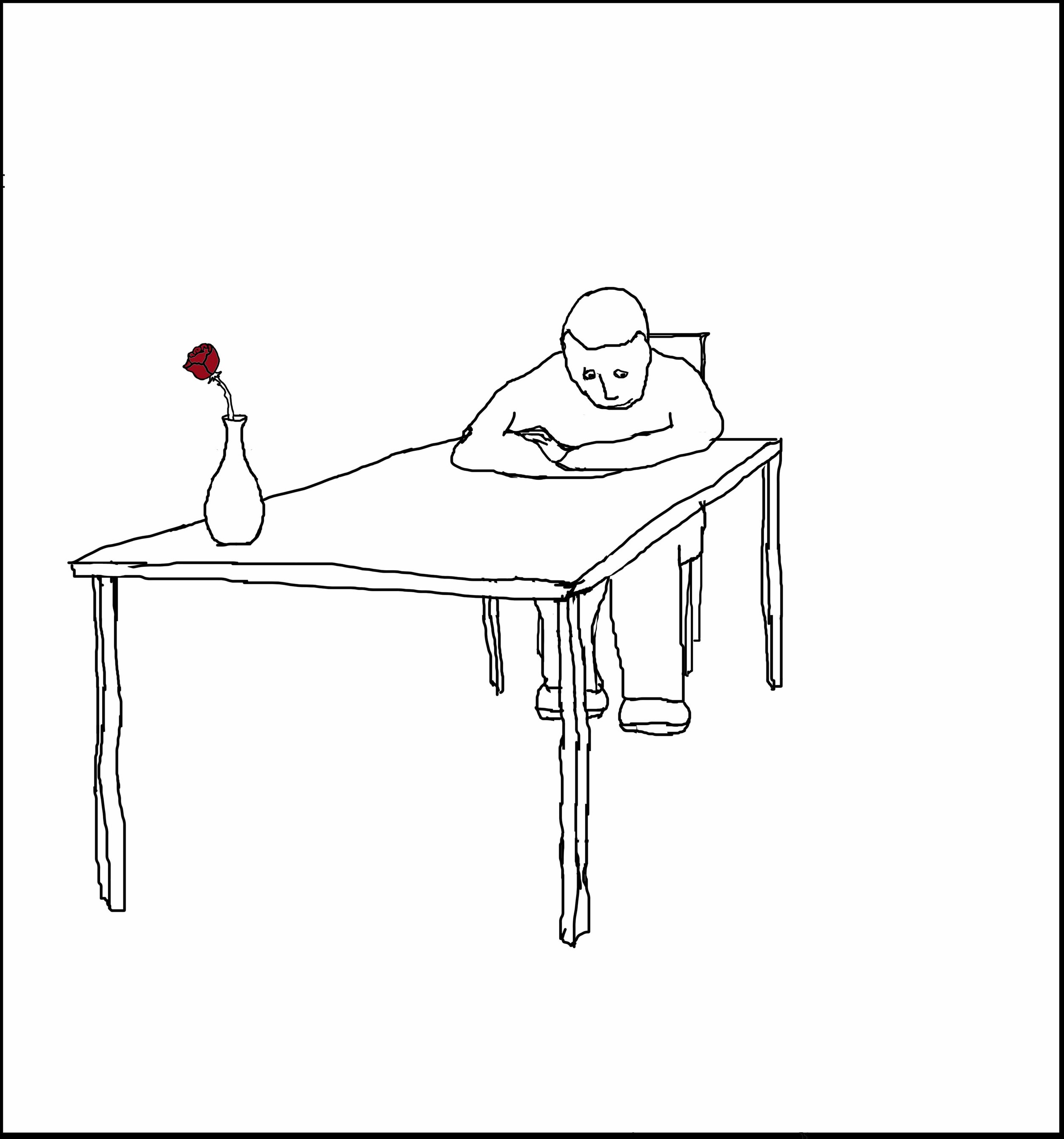
One thing that happens to you after you’ve fallen in love, if this love abides with you, whether the person does or not, so that the possibilities that had appeared in your mind when you and this person met have resolved themselves into one eventuality, and there no longer exists for you the question of whether, in the future, you’ll have the opportunity to see this person as often, or as nearly as often, as you’d like, since the answer will have made itself clear…yes, one thing that happens to you after you’ve gone through this falling in love, once the pain has subsided, if you and the person didn’t end up the way you’d hoped you would, or, if you did, once the happiness has ebbed, though not departed, is that upon you comes a resignation that isn’t unpleasant, but that ages you, even if you are young, so that the world, as you encounter it, no longer seems like a place inside of which you need to hurry, for what could there be to hurry toward?
diary /

Don’t let me become like Lily Briscoe, the painter from the novel To the Lighthouse, whose integrity I admire, whose indifference to success I would like to remember, and make my own, but whose fate, it seems, as a person among people, while not keeping her from understanding them, and interacting with them, and even, one might say, connecting with them in a way that goes beyond touch, or verbalization, is to live out her days alone.
diary /

An actor who played, in the movie I watched last night, a painter who lived more than a century ago, and who was so beset by what he called demons that, seeking to escape them, he hung himself from a tree in a field where he’d once liked to walk, and to set up his easel, and work with his brushes and oils, on canvas, also played, in a movie that was released around the same time, but that is set in today’s world, or in the era that we now call contemporary, though I suppose that won’t always be the case…yes, this actor also played, in this other movie, which I saw when it came out, a man who dressed expensively, who enjoyed fine food, and whose job it was to terminate, using a pistol to which he attached a silencer, individuals with whom his employer had had a disagreement.
diary /

In college I read The Death of Ivan Ilyich for a course in which it was assigned by a professor who made the remark, when she was paging through the syllabus with all of us students, on the first day of the semester, so that we’d seen the title of this work where it was printed, beside the dates by which we’d need to have it finished, that even though we could guess what would happen to the main character, without reading the story, based on what the author had chosen to call it, it was still worth reading, as its importance lay not in the fact that Ivan Ilyich died, for that fate awaited everyone, whether we appeared in a novel or not, but rather in how he died, or what could be said of the life that he lived before he died, which is what I remember now, whenever I see a copy of the book in a bookstore, or on a shelf in someone’s apartment, though this professor also said other things, all of them insightful, when, later in the term, she spent a couple of classes lecturing on it.
diary /

Some of the leaves I saw falling this morning, from the branches of trees on the street where I live, while I was walking toward the end of the block, where there’s a café at which I sometimes get coffee, I probably saw again, not much later, when I returned along the sidewalk in the direction from which I’d come, and happened to glance at the ground where they now lay, among other leaves, in scatterings and in piles, or strewn in irregular patterns, though of course I wouldn’t have been able to identify the ones I’d seen falling, had someone asked me to do so, for they all looked the same to me, in color and in shape, though they did vary in ways that would’ve been noticeable had I stopped to collect them and hold each of them up near my face, to regard them in the daylight, though the time and effort I would’ve expended on such an activity, without any purpose except the one I’ve described, might’ve caused me to appear frivolous or insane.
diary /

When I think of Lucifer and the fallen angels, I don’t think of them as rebelling, for that is too good a word for them, and does not really describe them, but instead I think of them as souring, like wine that has turned to vinegar, though I don’t mean to suggest that they soured by accident, or due to a defect in their nature, or because such an event was inevitable, but because, wanting to be higher than God, they chose to do so, although, in their envy, they obscured themselves to themselves, so that I imagine they wouldn’t have known that they were souring, unless they’d been able to look in a mirror, and behold the change in their countenance, by which point it would’ve been too late, the souring would’ve been complete, their choice would have been irrevocable, as indeed it was, for, as spirits, angels do not persist in time like us, who age, and who experience moments that elapse, and who thus can choose to return to God, if we have gone away, by a love or a caritas that begins in sorrow and is transformed, through the action of the will, into deeds that are not self-centered, although, eventually, death puts an end to our temporal lives, our chances for reconciliation disappear, and we find ourselves in eternity, heading in whatever direction the sum of our choices has taken us.
diary /

My rose garden dreams, set on fire by fiends.
diary /

It is said that John of Patmos, who is recognized as the author of the Book of Revelation, before he was banished to that island where he experienced the vision that I imagine he recorded, with ink, on parchment or a scroll of paper, though perhaps he used some other implement, or method of transcribing...yes, it is said that this John, before his exile to that place in the Aegean, though after the events in Jerusalem and in Galilee, so that he and the other apostles had begun their work as evangelists, which had already caused them to disperse, and find themselves far from the region where they were born…that this John, in what must have been intended as his execution, was plunged into boiling oil, inside the Colosseum, by the Roman authorities, under the Emperor Domitian, in response to his activities and his zeal, but came to no harm, the sight of which, once they’d had time to grasp it, brought the spectators to conversion, though they’d gone to the arena for the sake of entertainment.